KMS Elements
Statements and Actions
The Knowledge Management System (KMS) is built on statements and actions.
Statements are simple declarative statements that describe a domain of knowledge. Out of the box, all statements are of equal importance.
Actions are verb phrases. They range from performing mathematical operations to manipulating experimental equipment to designing experiments. Out of the box, all actions are of equal importance.
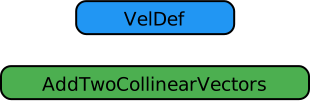
VelDef, the definition of velocity, is a statement. Its description is “An object's velocity is the instantaneous rate of change of its position.”
AddTwoCollinearVectors is an action. Its description is “Add two vectors that are collinear—having either the same or opposite directions.”
Prerequisites
Statements can have prerequisite relationships to other statements, and actions can have prerequisite relationships to other actions.
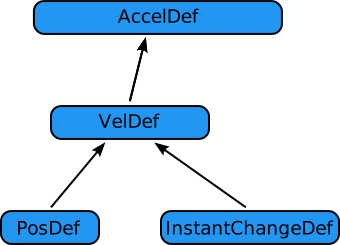
The definitions of position, PosDef, and an instantaneous change, InstantChangeDef, are prerequisites to VelDef. VelDef is a prerequisite to the definition of acceleration, AccelDef.
The KMS prerequisite is sometimes called a hard prerequisite. It means “You cannot understand velocity without understanding position.”
Taxonomy
Both statements and actions can be classified with taxonomies. A particular taxonomy consists of a category with several values. Statements and actions are assigned to category values as appropriate. A value of a category can be a category with its own values, so taxonomies can express multilevel hierarchies.
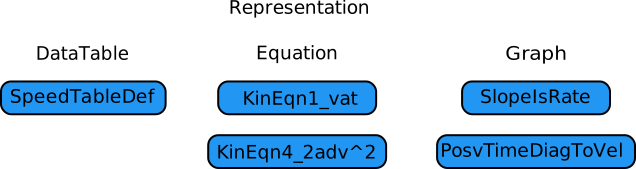
The taxonomy category is Representation. The values in this category are DataTable, Equation, and Graph. Some statements assigned to each value are shown.
Learning Goals
Learning goals describe something a student should be able to do with the content. A learning goal is derived from one or more statements and one or more actions.
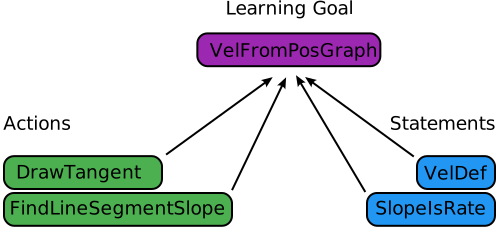
The learning goal is VelFromPosGraph. Its description is “Given a position v. time graph for an object in one-dimensional motion, the student can find the velocity at a particular time.” It is built from two actions, DrawTangent and FindLineSegmentSlope, and two statements, VelDef and SlopeIsRate.
Knowledge Bases and Courses
The KMS has two operational spaces: knowledge bases and courses.
A knowledge base, like “K-12 Physics,” describes content knowledge without respect to human concerns. Statements and actions are abstract entities, prerequisite relationships define hard logical dependencies, and taxonomies primarily play utility roles, like filtering. Learning goals, components of knowledge bases, bridge the space to courses.
A course, like “Middle School Physical Science,” represents a specific teaching context that:
- Selects learning goals from one or more knowledge bases
- Sequences statements and actions for teaching
- Maps knowledge onto calendar time
- Tracks coverage and progress
- Defines entry points for this particular teaching scenario
All of these elements are user-configurable. They can be modified and deleted, used or ignored, and new elements can be added.